Guides / What is a brilliant move in chess?
What is a brilliant move in chess?
In printed chess, two exclamation marks (!!) have always meant a move that is both strong and surprising: the kind of move a reader would not have found, and would not have trusted if they had. Game review tools turned that symbol into a label, Brilliant, and gave it rules. This page explains those rules as GChess Review applies them, shows real examples, and explains why most of the sacrifices you play will not, and should not, earn the label.
The short answer
A brilliant move is a sound sacrifice: you give up material, or leave it hanging, and the engine says it is still the best move on the board. It is not enough to be bold. The sacrifice has to work, and it has to matter.
The four rules
GChess Review labels a move Brilliant only when all of these hold. They are the same rules listed on the move classifications page.
- It is the engine's first choice. A sacrifice that the engine rates below another move is, by definition, not the best move, however pretty it is.
- It gives up material, or leaves it to be taken. Moving a piece to a square where it can be captured counts, as does ignoring a threat to a piece.
- You still stand at least even afterwards. The position after the move must be worth 0.5 expected points or more to you: a sacrifice that leaves you worse was a gamble, not a combination.
- The game was still open. If you were already winning by a mile (above 0.90 expected points), or the second-best move would have won anyway, the sacrifice is an elegant finish but not a brilliant one.
The fourth rule surprises people most. It is why the famous queen sacrifice at the end of Morphy's Opera Game is graded only Best: Morphy was winning with several moves by then. Brilliant is kept for sacrifices that change the course of a game, not for the last nail in a coffin that was already shut.
A real example: 11...Na4!!
The clearest examples come from the most famous game of the twentieth century, Donald Byrne against a 13-year-old Bobby Fischer, New York 1956. On move 11, Byrne has just played Bg5, attacking Fischer's knight on f6. Fischer answers by putting his other knight on a square where it can simply be taken:
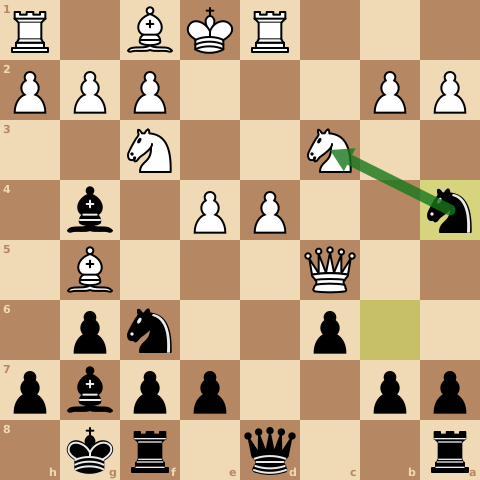
If White takes with 12.Nxa4, Black plays 12...Nxe4 and the e-file opens against White's uncastled king. White's king is still in the centre, and Black's pieces gain checks and open lines against it. That is why Byrne declined the knight with 12.Qa3. The engine agrees it is Black's best move, Black gives up material, the position stays good for Black, and nothing was decided before. All four rules hold, and the review marks it Brilliant.
The most famous one: 17...Be6!!
Six moves later Fischer leaves his queen to be taken. White's bishop on c5 attacks it, and instead of saving the queen, Fischer plays 17...Be6, attacking White's bishop on c4 and preparing a series of checks.
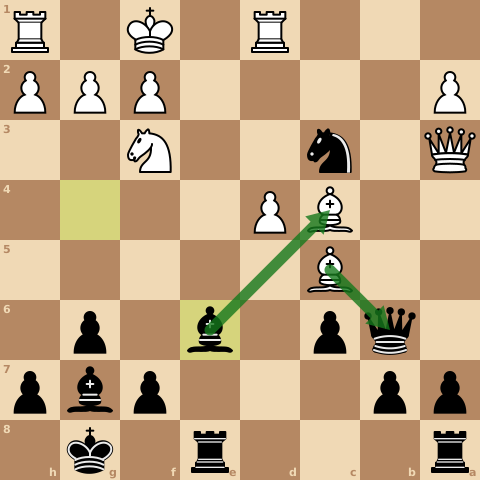
Byrne took the queen, and Fischer collected a rook, two bishops and a pawn with a "windmill" of discovered checks, ending with mate on move 41. In a GChess Review of the game, 17...Be6 is labelled Brilliant, together with 11...Na4 and 15...Nxc3. The full game, move by move, is on its own page.
Why your sacrifice was not Brilliant
When you play a sacrifice and the review calls it something else, it is usually for one of these reasons:
- It did not work. The engine found a defence, and your position after the sacrifice is worse. The label will be Inaccuracy, Mistake or Blunder, depending on how much it cost.
- It worked, but another move was better. If a quiet move kept a bigger advantage, the sacrifice is not the engine's first choice. It may still be Excellent or Good.
- You were already winning. A sacrifice that finishes a won game is graded Best. That is still a perfect move.
- It was not really a sacrifice. Capturing a defended piece with a less valuable one, or a trade of equal material, gives nothing up.
- A recapture. Taking back a piece that was just taken is not a sacrifice, however forced.
Brilliant and Great are different
A Great move is the only good move in a position: every other move would have cost a lot. It does not need a sacrifice. A Brilliant move needs a sacrifice but does not have to be the only good move. Some moves are both in spirit; the review picks Brilliant when the sacrifice rules hold.
How to find more of them
Brilliant moves come from calculation, and calculation is trained with puzzles. A few habits help:
- Look at checks, captures and threats first, including the ones that give material away. Most combinations start with a move that looks like a mistake.
- Count what you get back. A sacrifice is a trade: material now for a mating attack, a passed pawn or more material later.
- Notice open lines to the king. Both of Fischer's brilliant moves above opened a file or a diagonal toward an uncastled king.
- Train with themes. The tactics and checkmate puzzle books are sorted by pattern, so you can practise deflection, decoys and discovered attacks one at a time.
Is the label always right?
It is as right as the engine's search. In very sharp positions a deeper search can change the engine's first choice, and with it the label. That is why the review searches the critical moments a second time at full depth before it grades them, as described in how a review works. If a label surprises you, step through the engine's line on the board: it will show you why.