Guides / The Game of the Century, move by move
The Game of the Century, move by move
On 17 October 1956, in the Rosenwald Memorial tournament in New York, a 13-year-old Bobby Fischer beat Donald Byrne, one of the strongest players in the United States, in 41 moves. The chess writer Hans Kmoch called it "The Game of the Century", and the name stuck. It is still the game most often used to show what a queen sacrifice can do. Here it is, move by move, with what a modern engine review says about it.
The review in numbers
Reviewed in GChess Review at the Quick strength (Stockfish 19 Lite, depth 16), Fischer's accuracy is 97.0% and Byrne's 88.8%. The review marks three of Fischer's moves Brilliant (11...Na4, 15...Nxc3 and 17...Be6), one of Byrne's moves a Blunder (11.Bg5) and another a Mistake (18.Bxb6). A deeper search can shift a label in a position this sharp, but the story it tells is the classic one.
Moves 1–10: a quiet start
1.Nf3 Nf6 2.c4 g6 3.Nc3 Bg7 4.d4 O-O 5.Bf4 d5 6.Qb3 dxc4 7.Qxc4 c6 8.e4 Nbd7 9.Rd1 Nb6 10.Qc5 Bg4
The opening is a Grünfeld-style position. White builds a big centre with pawns on d4 and e4; Black has given up the centre for now and develops quickly, aiming at it with pieces. With 10.Qc5 White's queen has made three of White's first ten moves, and the king is still in the centre, while Black's king is castled and every Black piece is ready. That difference in development is what Fischer exploits.
Move 11: the blunder, and the first brilliancy
11.Bg5?? Na4!!
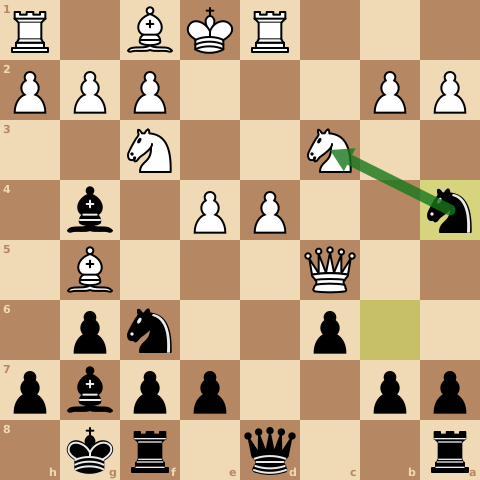
Byrne attacks the knight on f6, but in doing so leaves his king in the centre for one move too many. The review calls 11.Bg5 a blunder and prefers 11.Be2, simply finishing development and castling.
Fischer's answer is one of the most famous moves in chess. 11...Na4 puts the knight where White can take it. If 12.Nxa4, then 12...Nxe4 and the e-file opens toward White's king, with Black's pieces gaining checks and open lines against it. Byrne wisely declines.
Moves 12–15: the centre falls
12.Qa3 Nxc3! 13.bxc3 Nxe4 14.Bxe7 Qb6 15.Bc4 Nxc3!!
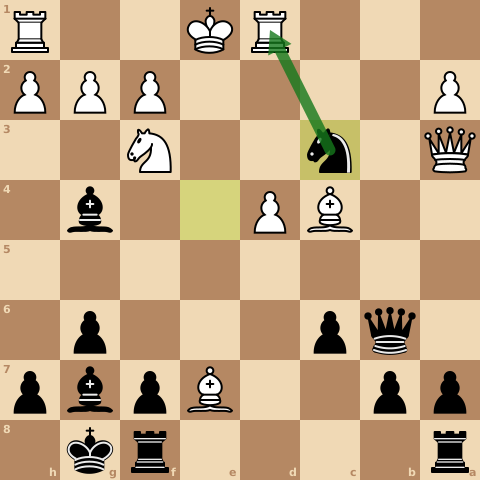
Fischer trades on c3 and takes the e4 pawn. White wins the e7 pawn and attacks the rook on f8, but Fischer leaves it and brings his queen to b6, eyeing the d4 pawn and the open b-file. Then 15...Nxc3, a second sacrifice: if 16.Qxc3, the rook goes to e8 and pins the bishop on e7 against White's king along the e-file. Byrne again declines.
Move 17: the queen sacrifice
16.Bc5 Rfe8+ 17.Kf1 Be6!!
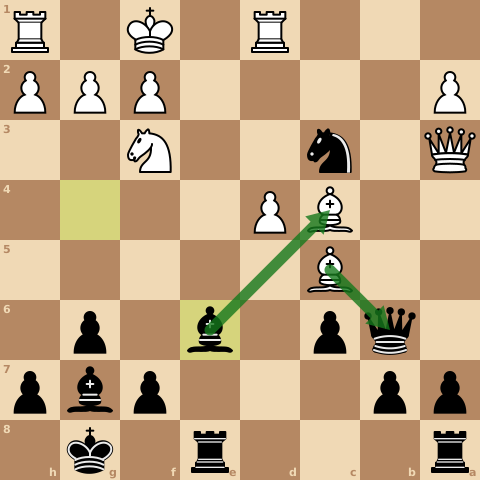
White's 16.Bc5 attacks the queen. Fischer checks first, forcing the white king to f1 so it can never castle, and then plays 17...Be6, ignoring the attack on his queen to hit the bishop on c4.
The point is in the lines where White does not take the queen. If 18.Bxe6, then 18...Qb5+ 19.Kg1 Ne2+ 20.Kf1 Ng3+ 21.Kg1 Qf1+ 22.Rxf1 Ne2#, a smothered mate. Other moves leave White facing the same attack, with Black's queen still on the board.
Moves 18–25: the windmill
18.Bxb6? Bxc4+ 19.Kg1 Ne2+ 20.Kf1 Nxd4+ 21.Kg1 Ne2+ 22.Kf1 Nc3+ 23.Kg1 axb6 24.Qb4 Ra4 25.Qxb6 Nxd1
Byrne takes the queen. What follows is a "windmill": the bishop on c4 and the knight give check after check, and every time the king moves, the knight lands on a new square with check while picking something up. Fischer takes the d4 pawn, retakes on b6 to collect the bishop, and finally takes the rook on d1.
When the dust settles, Black has given a queen and received a rook, two bishops and a pawn. Two bishops and a rook working together are worth far more than White's queen, and White's king still has no shelter.
Moves 26–41: Fischer finishes it
26.h3 Rxa2 27.Kh2 Nxf2 28.Re1 Rxe1 29.Qd8+ Bf8 30.Nxe1 Bd5 31.Nf3 Ne4 32.Qb8 b5 33.h4 h5 34.Ne5 Kg7 35.Kg1 Bc5+ 36.Kf1 Ng3+ 37.Ke1 Bb4+ 38.Kd1 Bb3+ 39.Kc1 Ne2+ 40.Kb1 Nc3+ 41.Kc1 Rc2#
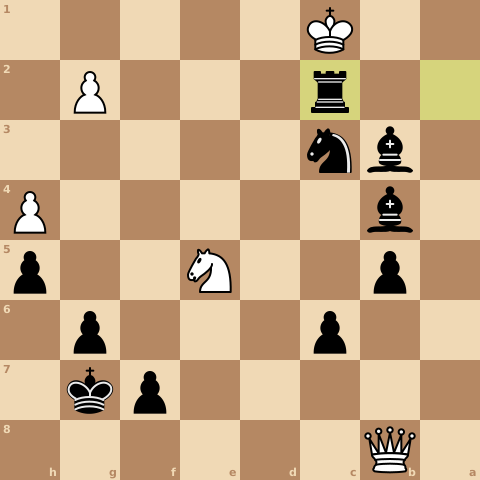
Byrne played on, perhaps out of respect, to let the young Fischer show the mate. Black's pieces drive the king across the board: bishop checks from c5, b4 and b3, knight checks from g3, e2 and c3, and the rook mates on c2. White's queen, the most powerful piece on the board, is never able to help.
What the game teaches
- Development beats material early on. White's queen moved three times in the first ten moves and White never castled; Black's pieces were all in play. The sacrifices worked because Black had more pieces ready.
- A king in the centre is a target. Every one of Fischer's brilliant moves aimed at the uncastled king, along the e-file or with checks.
- Count pieces, not just points. A queen is worth about nine pawns on paper. A rook, two bishops and a pawn, coordinated, were worth more.
- Look at what you get, not what you give. Fischer's moves look like losses one move deep and are wins several moves deep.
To see what the brilliant labels require, read what is a brilliant move. To get the same review of your own games, follow the analysis routine.