Guides / Chess opening traps every beginner should know
Chess opening traps every beginner should know
Many games below club level are decided in the first dozen moves, by a trap one player knew and the other did not. Learning the common ones protects you twice: you stop falling into them, and you learn the ideas behind them, which come up again and again in other positions. Here are six classics, from the shortest possible game to a trap that has caught strong players.
Each line below was checked move by move, and each diagram shows the final position.
1. Fool's Mate
1.f3 e5 2.g4 Qh4#
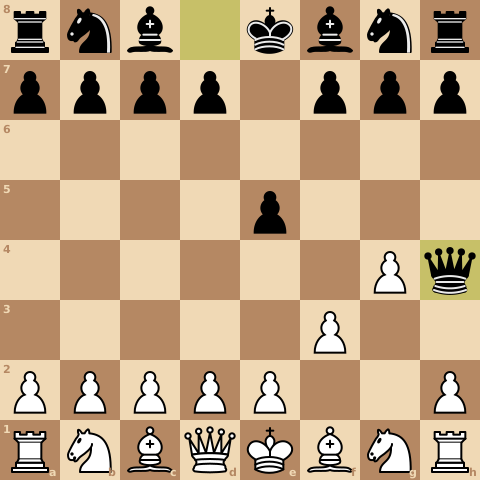
The idea: the pawns on f2 and g2 shield the king's diagonal. Push both early and the queen walks in. The lesson: early f-pawn and g-pawn moves weaken your king more than they look. You will rarely see this exact game, but the same diagonal decides many quick games.
2. Scholar's Mate
1.e4 e5 2.Bc4 Nc6 3.Qh5 Nf6?? 4.Qxf7#
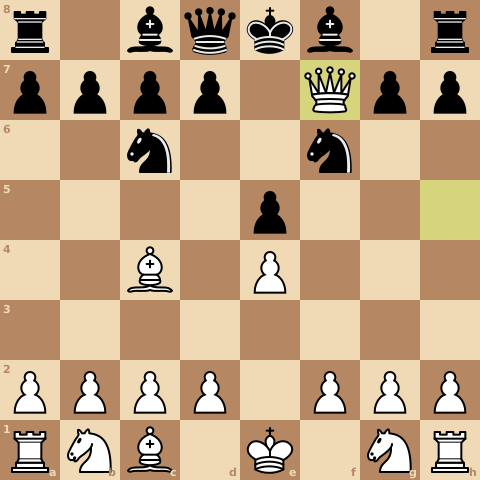
The idea: f7 (f2 for White) is the weakest square in the starting position. How to avoid it: defend f7 and attack the queen at the same time. 3...g6 or 3...Qe7 both stop the mate, and 3...g6 even attacks the queen. Never answer Qh5 by developing a knight that does not cover f7.
3. Legal's Mate
1.e4 e5 2.Nf3 d6 3.Bc4 Bg4 4.Nc3 g6? 5.Nxe5! Bxd1?? 6.Bxf7+ Ke7 7.Nd5#
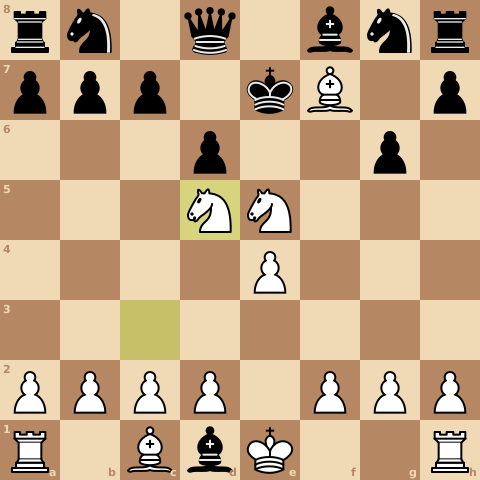
The idea: the bishop on g4 pins the knight to the queen, so the knight looks stuck. It is not: moving it offers the queen, and taking the queen allows mate. The lesson: a pin against the queen is not an absolute pin. If 5.Nxe5 is played against you, take the knight with 5...dxe5 instead of the queen: you lose a pawn, not the game.
4. The Blackburne Shilling Gambit
1.e4 e5 2.Nf3 Nc6 3.Bc4 Nd4!? 4.Nxe5? Qg5! 5.Nxf7 Qxg2 6.Rf1 Qxe4+ 7.Be2 Nf3#
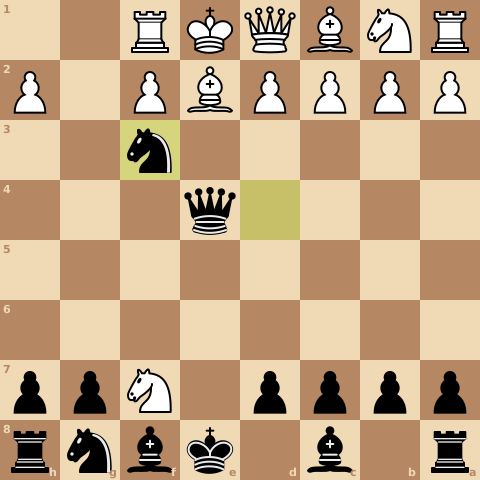
The idea: 3...Nd4 looks like a beginner's mistake that drops the e5 pawn. When White grabs it, Black's queen attacks the knight on e5 and the pawn on g2 at once, and the attack runs straight into White's king. How to avoid it: White simply does not take on e5. 4.Nxd4 exd4 5.c3 or 5.O-O gives White a good game, and shows that 3...Nd4 is objectively weak. It is a trap, not an opening to rely on.
5. The Fried Liver Attack
1.e4 e5 2.Nf3 Nc6 3.Bc4 Nf6 4.Ng5 d5 5.exd5 Nxd5?! 6.Nxf7! Kxf7 7.Qf3+
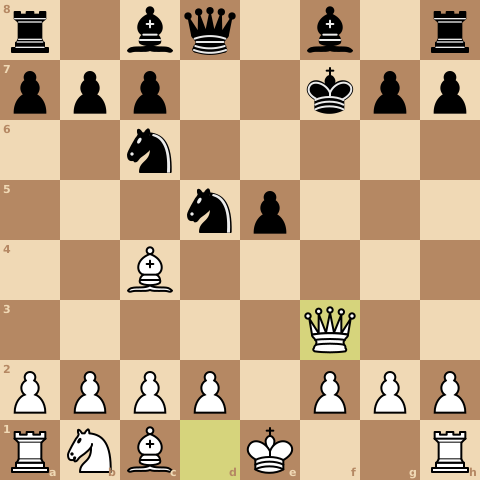
The idea: after 5...Nxd5 the knight on d5 is defended only by the queen and is pinned against f7 by the bishop on c4. The sacrifice on f7 drags the king out, and Black's best is usually to walk the king to e6 to keep the knight. This is not a forced win, but in practice Black's king is in great danger. How to avoid it: after 4.Ng5, Black's main replies are 4...d5 5.exd5 Na5 (not 5...Nxd5) or the counterattack 4...Bc5. Both are well-tested.
6. The Elephant Trap
1.d4 d5 2.c4 e6 3.Nc3 Nf6 4.Bg5 Nbd7 5.cxd5 exd5 6.Nxd5?? Nxd5!
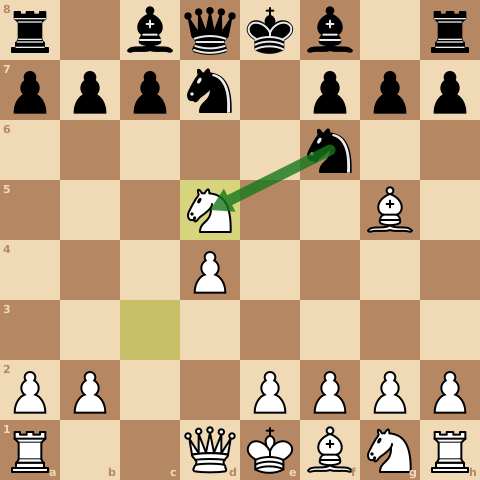
The idea: White sees that the knight on f6 is pinned to the black queen and wins a "free" pawn on d5. But Black can ignore the pin: after 7.Bxd8, the check 7...Bb4+ wins the queen back, and Black ends a piece up for a pawn. The lesson: before winning material through a pin, look for checks that break it.
What the traps have in common
- f7 and f2 are weak at the start. Three of the six traps end there.
- Pins can be broken, with checks or with counter-sacrifices. Legal's Mate and the Elephant Trap both punish a player who trusted a pin too much.
- Greed is the bait. In almost every trap, the losing move takes something: a pawn, a knight, a queen.
- The king in the centre is a target. Castle early and the Fried Liver and Legal's Mate lose their force.
Find the traps in your own games
When you lose quickly, a review usually shows one move marked Blunder or Mistake in the first ten moves, often a capture. Paste the game into GChess Review, find the first red label, and compare your move with the engine's line. The opening puzzle book trains exactly these patterns, with almost 3,000 positions sorted by opening.